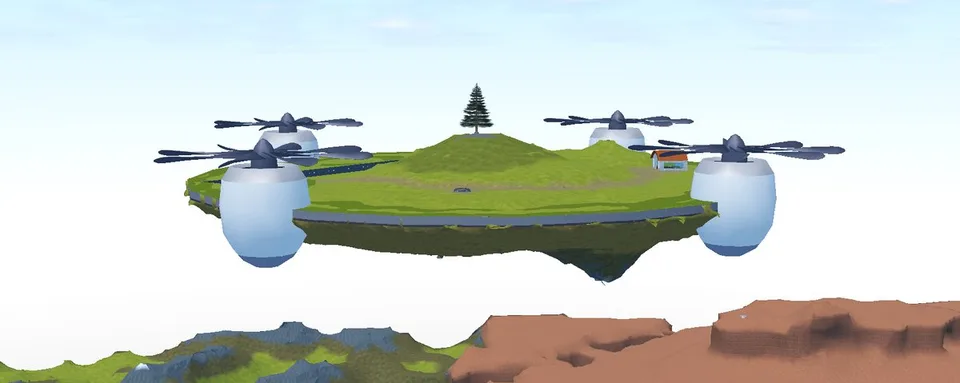
Plane Crazy shows two spheres while you build a flying creation. The yellow sphere is the center of mass. The blue sphere is the center of lift. For a steady winged plane, put them on top of each other. Flight without an overlap is possible, and too little lift means the build cannot fly at all.
How to read a bad plane
Launch, watch the first two seconds, then return and move one thing.
| What you see | What to move |
|---|---|
| Instant flip or a violent pitch | The spheres are far apart. Slide wing panels forward or back until yellow and blue meet. |
| Never climbs at full throttle | Lift is too low. Add wing panel, not more control surface. Control surfaces lift less than wings. |
| Nose sinks only after you fit a jet | Try a little horizontal wing panel in the nose, and expect extra drag. |
| Nose wanders sideways | Check that engines and wings mirror each other, then test a small vertical panel in the nose. |
| Controls feel backward | The grey side of a control surface is facing forward. Turn those parts around. |
Change wings in small steps. A one-block shift is enough to see the spheres move.
Engines do not fix a bad wing
A propeller, jet, and rocket push. They do not decide where lift sits. Adding a bigger engine to a plane whose spheres are apart usually makes the same pitch happen faster.
Documented engine order, from the parts notes rather than from a single thrust number:
- Small Propeller Engine: lowest thrust in the propeller family, two blades.
- Propeller Engine: more thrust and speed than the small one, three blades. This is the starter tutorial engine.
- Jet Engine: stronger than a propeller.
- Large Jet Engine: stronger than the jet, and 2 blocks by 2.
- Huge Jet Engine: 3 by 3 and stronger than the large jet, with a written thrust-to-weight under 1, so it will not lift itself when pointed straight up.
- Rocket engines: a separate, higher-power family. Public part lists disagree on exact multipliers, so compare rocket, large rocket, super rocket, and huge rocket on a test stand instead of trusting one ranking.
Hover and massless builds are a different problem
Hover-engine drag can be set to resist motion. Combined with a massless core, builders use that resistance to hold a creation in the air. That is a technique, not the starter-plane method. A massless build can be flung on contact with the water because of its buoyancy. Constraint parts other than a Motor 2 with torque over 100 still have mass, which is why some massless builds wobble as speed rises.
Keep the first plane heavy enough to sit on the plot, winged, and overlapped. Move on to hover, gyros, or a massless core only after a normal wing arrangement already flies.